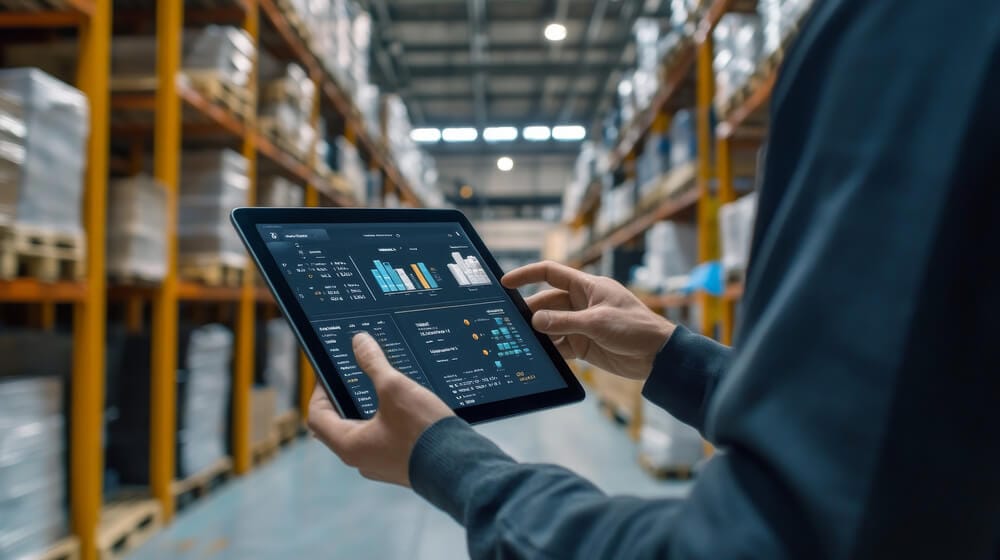
Real-Time Inventory Tracking: Why Manual Checks Are No Longer Enough
Warehouse managers once relied on barcode scanners and manual stock-taking to keep inventory records accurate. This approach was slow and prone to errors. With IoT smart warehouses, inventory tracking has become fully automated.
How does it work?
- RFID tags and sensors update stock levels as goods move through the warehouse.
- AI-powered analytics help predict demand and prevent stock shortages.
- GPS trackers enable real-time monitoring of shipments in transit.
The benefits:
Accurate inventory = fewer delays and stock shortages
Automated tracking = reduced human errors and miscounts
With IoT-WorkS, businesses can move beyond outdated systems, using real-time updates to make faster, data-driven decisions and improve supply chain efficiency.
Predictive Maintenance: Preventing Downtime and Equipment Failures
Warehouse automation depends on machines like conveyor belts and robotic pickers. If these systems fail unexpectedly, operations stall. IoT-WorkS helps businesses prevent costly breakdowns with predictive maintenance solutions.
How does it work?
- Sensors detect vibrations, temperature changes, and unusual patterns in equipment.
- AI-powered analytics predict failures based on usage data and performance trends.
- Automated alerts notify maintenance teams about potential issues before they escalate.
Instead of waiting for breakdowns to occur, warehouses can schedule maintenance at optimal times, ensuring machines remain operational. This reduces repair costs and extends equipment lifespans.
Predictive maintenance is particularly valuable for high-volume warehouses, where even minor delays can impact deliveries. By integrating IoT with machine learning, businesses can create a proactive approach to equipment maintenance, keeping operations smooth and efficient.
Safer Work Environments: Reducing Accidents and Risks
Warehouses are high-traffic areas with moving equipment, workers, and heavy loads. Safety risks include collisions, temperature fluctuations, and unauthorised access. IoT-based monitoring systems improve security and workplace safety.
- Smart cameras detect unauthorised entry in restricted zones.
- Wearable sensors monitor worker fatigue and prevent accidents.
- Temperature and humidity sensors protect perishable goods.
Better safety monitoring = fewer workplace incidents and improved compliance.
What should warehouses monitor for safety?
- Are forklifts and robotic systems operating at safe speeds? IoT-WorkS tracks and limits vehicle speeds.
- Are workers wearing the required safety gear? Wearable tech can detect compliance.
- Are temperature-sensitive goods being stored correctly? IoT sensors provide real-time updates.
With continuous monitoring, warehouses can respond to safety threats before they escalate.
How Does IoT Speed Up Picking and Packing?
Fast and accurate order fulfilment is crucial, especially in high-volume warehouses. IoT-WorkS simplifys picking and packing through automation.
How it works:
- AI-driven robots transport goods to pickers, reducing walking time.
- Smart conveyors prioritise orders based on shipping deadlines.
- Automated sorting systems speed up packing and dispatch.
The result?
- Fewer picking errors
- Faster shipments
- Lower labour costs
By reducing human intervention, IoT-WorkS ensures efficient order movement from shelf to shipment, improving delivery times and customer satisfaction.
IoT Supply Chain Visibility: End-to-End Transparency
Logistics doesn’t stop at the warehouse. Supply chains involve multiple stakeholders, from manufacturers to distributors and retailers. Communication gaps can lead to delays, misplaced shipments, or unexpected disruptions. IoT supply chain solutions improve visibility across the entire network.
- GPS and IoT-enabled fleet tracking provide real-time shipment updates.
- Condition monitoring ensures perishable goods remain within safe temperature ranges.
- Digital twins create virtual models of supply chain operations, identifying inefficiencies.
Better transparency allows businesses to anticipate delays and take steps to avoid problems. This visibility is especially important for industries that handle perishable goods, pharmaceuticals, or valuable shipments.
Tracking shipments in real time also improves customer service. Retailers and consumers can get accurate delivery estimates, which increases overall satisfaction. The Internet of Things (IoT) is making warehouses more efficient and changing how goods move throughout the supply chain.
Can IoT Reduce Warehouse Energy Costs?
Warehouses consume significant energy, but IoT-WorkS solutions help cut unnecessary consumption.
How?
- Smart lighting adjusts based on occupancy.
- Automated HVAC systems optimise temperature settings.
- Power analytics identify energy waste during off-peak hours.
The impact:
- Lower operating costs
- Improved energy efficiency
- Extended equipment lifespan
By automating energy management, IoT-WorkS helps warehouses reduce expenses while maintaining optimal performance—especially for facilities storing temperature-sensitive goods.
Frequently Asked Questions
What makes a warehouse smart?
A smart warehouse integrates IoT sensors, automation, and data analytics to optimise operations. Key characteristics include real-time inventory tracking using RFID or barcode scanning, automated picking and packing systems, IoT-monitored environmental conditions, connected forklift and vehicle management, predictive maintenance for handling equipment, and a warehouse management system that coordinates all automated and human activities.
How does IoT improve warehouse efficiency?
IoT improves warehouse efficiency by providing real-time inventory visibility that eliminates time-consuming manual stock counts, tracking asset and personnel locations to optimise workflows, monitoring equipment health to prevent breakdowns, automating order fulfilment processes, and generating data that identifies bottlenecks and inefficiencies. Warehouses with full IoT deployment report productivity improvements of twenty to thirty-five percent.
What IoT sensors are used in smart warehouses?
Smart warehouses use RFID readers and tags for inventory tracking, barcode scanners integrated with WMS systems, temperature and humidity sensors for climate control, motion sensors and people counters for safety and efficiency monitoring, vibration sensors on forklifts and conveyor systems for predictive maintenance, GPS and UWB sensors for indoor asset location, and load sensors on racking and vehicles.
How does IoT reduce warehouse operating costs?
IoT reduces warehouse costs by eliminating labour-intensive manual counting, reducing picking errors that cause returns and reprocessing costs, optimising energy consumption in climate-controlled areas, preventing equipment failures through predictive maintenance, reducing inventory losses through accurate real-time tracking, and improving space utilisation through data-driven slotting strategies.
What is the future of IoT in warehouse logistics?
The future of IoT in warehouse logistics includes autonomous mobile robots guided by real-time IoT data, digital twin simulations that optimise layouts before physical changes, AI-driven demand forecasting integrated with live inventory data, drone-based cycle counting, and fully automated receiving and despatch processes. These developments will further reduce operating costs and enable same-day fulfilment at scale.